

The Trinity Question

There is a controversy going on in our beloved Seventh-day Adventist Church. This controversy is whether or not the Trinity is Biblical or pagan. The main part of the anti-trinitarian belief seems to be that it is only God the Father, and God the Son, Jesus, and that the Holy Spirit is just an impersonal force, or is Jesus Himself. In other words, they believe there are only two members of the Godhead, not three. At least one reason for their believing this is that they believe the Trinity is a catholic doctrine, and they want to move away from paganism. This is a noble desire, to move away from paganism. But just because the catholic church uses the word trinity, it does not make the Biblical truth on the subject a lie. Could it be, that like other truths from the Bible, the Catholic church just borrowed it and perverted it, like they did with other things, like communion?
So is God two, or three? Let’s start off in the Hebrew. In the creation account in Genesis, the name for God that Moses used is “Elohiym.” This word is used over 2,600 times in the Old Testament. So we for sure know that the Godhead has more than one member. Now before you say, “See there it is! Proof that God is only two,” keep reading. Let’s study this out.
31 times in the Bible, we see the phrase “the Spirit of the Lord.” Because this is phrased this way, many thus believe that the Holy Spirit is the impersonal spirit of God. But is the Bible really saying this? Let’s look at Ezekiel 11:5 and see how the Bible clarifies itself:
“And the Spirit of the LORD fell upon me, and said unto me…”
Can an impersonal force speak? Of course not. Let’s look at Acts 5. In the story of Ananias and Sapphira, here was a couple that wanted to appear holy, without actually being holy. They sold part of their land, gave part of the proceeds to the apostles, but lied and said they had given all the money. The Holy Spirit gives Peter insight into their hearts, and Peter says,
“why hath Satan filled thine heart to lie to the Holy Ghost, and to keep back part of the price of the land? Whiles it remained, was it not thine own? and after it was sold, was it not in thine own power? why hast thou conceived this thing in thine heart? thou hast not lied unto men, but unto God…How is it that ye have agreed together to tempt the Spirit of the Lord?” (Acts 5:3,4, & 9.)
Here Peter clearly says that the Holy Spirit is God. He doesn’t say, “You have lied to an impersonal force.” He says they lied to the Holy Spirit, then specifies they lied to God, then says they tempted the Spirit of the Lord. So what’s going on here? Peter is saying the Holy Spirit is God, that He is not some impersonal force. The phrase, the Spirit of the Lord, is being used to describe the Holy Spirit as a person.
Now, some will use 2 Corinthians 3:17 to say the Holy Spirit is Jesus Himself, or an impersonal force. “Now the Lord is that Spirit…” All Paul is saying here is that where God is, there is freedom. We cannot take one takes that seems to say one thing, and pit it against many other texts that clarify what this truth is.
Check out how these 3 different versions translate this text:
Now, “Adonai” in this text means the Spirit. And where the Spirit of Adonai is, there is freedom. (Complete Jewish Bible.)
Now, “the Lord” in this passage is the Spirit; and where the Spirit of the Lord is present, there is freedom. (Good News Translation.)
And the Spirit is the Lord; and where the Spirit of the Lord is, there is freedom. (Wycliffe Bible.)
But let’s go a step further and cross reference 2 Corinthians 3:17 with a few other passages:
“And because ye are sons, God hath sent forth the Spirit of his Son into your hearts, crying, Abba, Father.” (Galatians 4:6.)
“And hope maketh not ashamed; because the love of God is shed abroad in our hearts by the Holy Ghost which is given unto us.” (Romans 5:5.)
“But ye are not in the flesh, but in the Spirit, if so be that the Spirit of God dwell in you. Now if any man have not the Spirit of Christ, he is none of his.” (Romans 8:9.)
“And grieve not the holy Spirit of God, whereby ye are sealed unto the day of redemption.” (Ephesians 4:30.)
Here we see something important. The terms, Spirit of God, Spirit of Christ, the Holy Ghost, and the Holy Spirit, are synonymous. The Bible is a very specific, very detailed book. Nothing is in there by accident. So when we have a group of verses like this, it becomes clearer that there are three in the Godhead. But let’s look at a few more.
“The grace of the Lord Jesus Christ, and the love of God, and the communion of the Holy Ghost, be with you all.” (2 Corinthians 13:14.)
Here in this one, we see all three members of the Godhead present. The Father, Jesus, and the Holy Spirit are presented as three distinct beings.
“And Jesus, when he was baptized, went up straightway out of the water: and, lo, the heavens were opened unto him, and he saw the Spirit of God descending like a dove, and lighting upon him: And lo a voice from heaven, saying, This is my beloved Son, in whom I am well pleased.” (Matthew 3:16-17.)
Here again, we have all three. Now, some will say, “See, it says Spirit of God! So the Holy Spirit is not a person.” Well, now, hold onto your horses, my friends. Couple that together with 2 Corinthians 13:14. All of a sudden it becomes clear that there are three members of the Godhead, not just two.
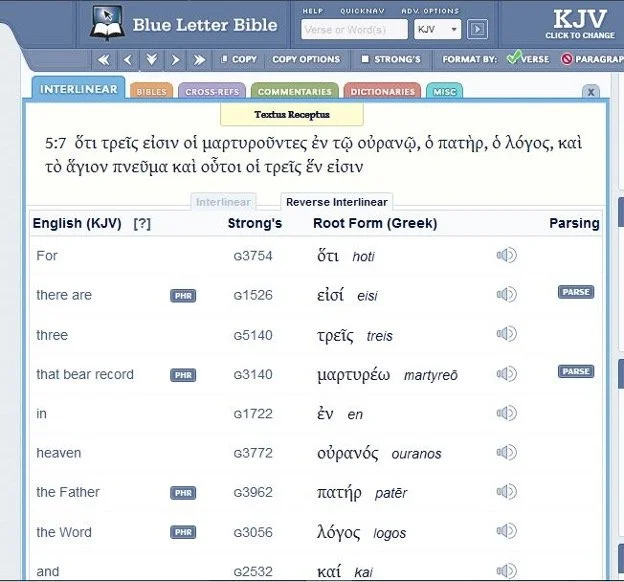
“For there are three that bear record in heaven, the Father, the Word, and the Holy Ghost: 1and these three are one.” (1 John 5:7.)
Ok, I know some already object to this one. They say the latter half of this verse is not in the earliest manuscripts. And for those people, I recommend watching a couple of videos by Professor Walter Veith: Battle of the Bibles, and Changing the Word. He makes it clear that age doesn’t always mean better. He also proves that the Textus Receptus is the best manuscript tree we have available. And my friends, the entirety of 1 John 5:7 is in the Textus Receptus. I will screen shot from blueletterbible.org.
Let’s look at more. At the very end of Matthew, we read this:
Go ye therefore, and teach all nations, baptizing them in the name of the Father, and of the Son, and of the Holy Ghost: (Matthew 28:19.)
Anti-trinitarians claim that this verse does not support the personality of each member of the Godhead. But if that is the case, then God is just an impersonal force, and panentheism is the truth. But we know this isn’t the case! Panentheism is heresy. If Matthew 28:19 does not support the personality of the Holy Spirit, then it is the same for the Father and the Son. On the other side of the coin, if the Father and the Son are persons with personalities, then so is the Holy Spirit. Pick one, people. They are either all persons, or all impersonal forces. This verse doesn’t say one way or the other, because God never meant for this to be the debate and the controversy that it is in our church!
Honestly, folks, we’re majoring in the minors here. We are allowing this doctrine, a beautiful one at that, to become a dividing line between us. And that is exactly what Satan wants. A divided church cannot conquer. There are people on both sides of this issue that treat the other side like a bucket of horse excrement. But let’s look at Ellen G. White now. Some claim she wasn’t Trinitarian. But is this true? Observe:
The Holy Spirit always leads to the written word. The Holy Spirit is a person; for He beareth witness with our spirits that we are the children of God. - 20MR 68.5
The Holy Spirit has a personality, else He could not bear witness to our spirits and with our spirits that we are the children of God. He must also be a divine person, else He could not search out the secrets which lie hidden in the mind of God. - 20MR 69.1
The three great powers of heaven pledge themselves to furnish to the Christian all the assistance he requires. The Spirit changes the heart of stone to the heart of flesh. And by partaking of the word of God, eating the flesh and drinking the blood of His Son, Christians obtain an experience that is after the divine similitude. When Christ abides in the heart by faith, the Christian is the temple of God. - 4MR 368.5
Keep yourselves where the three great powers of heaven, the Father, the Son, and the Holy Spirit, can be your efficiency. - SW February 23, 1904
“Through the Scriptures the Holy Spirit speaks to the mind, and impresses truth upon the heart. Thus He exposeserror, and expels it from the soul. It is by the Spirit of truth, working through the word of God, that Christsubdues His chosen people to Himself.
“Sin could be resisted and overcome only through the mighty agency of the Third Person of the Godhead, who would come with no modified energy, but in the fullness of divine power. It is the Spirit that makes effectual what has been wrought out by the world’s Redeemer. It is by the Spirit that the heart is made pure. Through the Spiritthe believer becomes a partaker of the divine nature. Christ has given His Spirit as a divine power to overcome all hereditary and cultivated tendencies to evil, and to impress His own character upon His church.
“’When He [the Spirit of truth] is come, He will reprove the world of sin, and of righteousness, and of judgment.” The preaching of the word will be of no avail without the continual presence and aid of the Holy Spirit. This is the only effectual teacher of divine truth. Only when the truth is accompanied to the heart by the Spirit will it quicken the conscience or transform the life. (The Desire of Ages, page 671.)
Question: Can an impersonal force teach? Can an impersonal force convict of sin? Simply put, no. Let’s look at John chapters 14 to 16. I think we’ve settled with these quotes that Ellen G. White believed in the three member Godhead. Some like to quote from Evangelism to say the Holy Spirit is a person. But I quote directly from the manuscript that quote in Evangelism is pulled from, because anti-trinitarians like to claim that since Evangelism was compiled by a known Jesuit, that we can’t trust it. However, even if it was, she still wrote that quote.
At least 18 times in these chapters, the Holy Spirit is referred to as a HE. Starting in John 14:16, Jesus begins talking about the Holy Spirit. Let’s take a closer look at verses 16-18.
“And I will pray the Father, and he shall give you another Comforter, that he may abide with you for ever; Even the Spirit of truth; whom the world cannot receive, because it seeth him not, neither knoweth him: but ye know him; for he dwelleth with you, and shall be in you. I will not leave you comfortless: I will come to you…But the Comforter, which is the Holy Ghost, whom the Father will send in my name, he shall teach you all things, and bring all things to your remembrance, whatsoever I have said unto you.” (John 14:16-18, 26.)
Perhaps one reason anti-trinitarians have a hard time believing in the personhood of the Holy Spirit, is the kind of names given to Him. The Spirit of Truth; the Spirit of God; the Spirit of Christ. But just like the Father and the Son, there are various names given to them to describe different aspects of their personality. The Holy Spirit is not just the Spirit of Truth, but He is also the Comforter, and Teacher, etc..
But notice: verse 14 here says ANOTHER. The word in the Greek literally means else, as in something else, or more, another, some other, referring to someone different. Jesus goes on to call Him the Spirit of Truth, and in these 3 verses alone, Jesus calls the Holy Spirit He and Him over four times. Question: Why would Jesus refer to an impersonal force, or as some like to say, to Himself, as a He?
Jesus said He would come to us and will not leave us comfortless. Jesus, since His incarnation as a human, is forever linked with humanity, and has thus given up His omnipresent. He can only be such through the person of the Holy Spirit. We may not clearly understand this completely, but if we could completely understand God, then He wouldn’t be God.
Verse 27 says the Holy Spirit would come to us in the name of Jesus. Why would Jesus say this, if they are one and the same person? Why would He call the Holy Spirit ANOTHER Comforter, referring to Him with personality pronouns, if the Holy Spirit was an impersonal force? Let’s move onto John 15 and 16.
“But when the Comforter is come, whom I will send unto you from the Father, even the Spirit of truth, which proceedeth from the Father, he shall testify of me..” (John 15:26.)
“Nevertheless I tell you the truth; It is expedient for you that I go away: for if I go not away, the Comforter will not come unto you; but if I depart, I will send him unto you. And when he is come, he will reprove the world of sin, and of righteousness, and of judgment: Of sin, because they believe not on me; Of righteousness, because I go to my Father, and ye see me no more; Of judgment, because the prince of this world is judged. I have yet many things to say unto you, but ye cannot bear them now. Howbeit when he, the Spirit of truth, is come, he will guide you into all truth: for he shall not speak of himself; but whatsoever he shall hear, that shall he speak: and he will shew you things to come. He shall glorify me: for he shall receive of mine, and shall shew it unto you. All things that the Father hath are mine: therefore said I, that he shall take of mine, and shall shew it unto you.” (John 16:7-15.)
Let’s talk about John 15:26 real quick. It says the Holy Spirit proceeds from the Father. Some may say, “See, it says from the Father. That means the Holy Spirit is not a person.” Hold onto your horses again. The Greek literally means to be discharged, to go out, and depart. The Holy Spirit is not a part of the Father. He is a separate person. And again, an impersonal force cannot teach, or comfort.
Let’s finish off with another quote from the Pen of Inpsiration.
“The Father and the Son alone are to be exalted.” (The Youth's Instructor, July 7, 1898.)
The office of the Holy Spirit is to exalt the Father and the Son. He does not seek glory for Himself. The Father is the supreme Monarch of the universe that they created. The Son is the Messiah, the Savior, the Lamb who was slain for us. The Holy Spirit does not point to Himself, because He did not die for us. He points to the Father, because He is the great Lawgiver. He points to Jesus, because without His life and death, and resurrection, we are all doomed.
Beloved, answer this question honestly: does it affect God’s ability to save us if He is three, as opposed to two? Is God any less powerful if there is a trinity, verses just two? Let’s stop majoring in the minors and get the Gospel out. Satan loves to have us squabbling with each other. A couple years ago, it was women’s ordination. Now it’s a controversy over the personhood of the Holy Spirit. Let’s stop fighting, and unite in Jesus so we can finish the work.
And just in case someone uses the last quote from above as an excuse to keep fighting this ridiculous fight, here it is in context. Ellen G. White is not saying the Holy Spirit isn’t a person with this quote, or that the only members of the Godhead are the Father and the Son. She is saying that men should not be exalted, but God should be exalted and glorified.
“It is not men whom we are to exalt and worship; it is God, the only true and living God, to whom our worship and reverence are due. According to the teaching of the Scriptures, it dishonors God to address ministers as “reverend.” No mortal has any right to attach this to his own name, or to the name of any other human being. It belongs only to God, to distinguish Him from every other being.... “Holy and reverend is his name.” We dishonor God when we use this word where it does not belong.... The Father and the Son alone are to be exalted.” (The Youth's Instructor, July 7, 1898.)
There are people who claim that Jesus is not God, or that Jesus was created at some point in the past. Even the Jehovah’s Witnesses claim that Jesus is not God. But is this the case? Observe the following texts, and you will see Jesus is not only fully God, but He is the Creator, He was never created, and He is the God of the Old Testament. To claim Jesus is anything less is to say that He cannot be God, and if He is not God, He cannot be our Savior. But these texts make it plain that Jesus is fully God, the Creator, not the created.
Romans 1
John 1
Colossians 1:16
Isaiah 44:6
Thus saith the LORD the King of Israel, and his redeemer the LORD of hosts; I am the first, and I am the last; and beside me there is no God.
Isaiah 48:12
Hearken unto me, O Jacob and Israel, my called; I am he; I am the first, I also am the last.
Exodus 3:14
And God said unto Moses, I Am That I Am: and he said, Thus shalt thou say unto the children of Israel, I Am hath sent me unto you.
John 8:58
Jesus said unto them, Verily, verily, I say unto you, Before Abraham was, I am.
Revelation 1:11
Saying, I am Alpha and Omega, the first and the last: and, What thou seest, write in a book, and send it unto the seven churches which are in Asia; unto Ephesus, and unto Smyrna, and unto Pergamos, and unto Thyatira, and unto Sardis, and unto Philadelphia, and unto Laodicea.
Revelation 1:17
And when I saw him, I fell at his feet as dead. And he laid his right hand upon me, saying unto me, Fear not; I am the first and the last:
Revelation 2:8
And unto the angel of the church in Smyrna write; These things saith the first and the last, which was dead, and is alive;
Revelation 22:13
I am Alpha and Omega, the beginning and the end, the first and the last.
— Ms 21, 1906, pars. 9–10
“All these spiritualistic representations are simply nothingness. They are imperfect, untrue. They weaken and diminish the Majesty which no earthly likeness can be compared to. God cannot be compared with the things His hands have made. These are mere earthly things, suffering under the curse of God because of the sins of man. The Father cannot be described by the things of earth. The Father is all the fullness of the Godhead bodily and is invisible to mortal sight. The Son is all the fullness of the Godhead manifested. The Word of God declares Him to be ‘the express image of His person.’ [Hebrews 1:3.] ‘God so loved the world that He gave His only begotten Son, that whosoever believeth in Him should not perish, but have everlasting life.’ [John 3:16.] Here is shown the personality of the Father.”
— 21LtMs, Ms 21, 1906, pars. 9–10
Ellen G. White — Ms 21, 1906, par. 11
“The Comforter that Christ promised to send after He ascended to heaven, is the Spirit in all the fullness of the Godhead, making manifest the power of divine grace to all who receive and believe in Christ as a personal Saviour. There are three living persons of the heavenly trio; in the name of these three great powers—the Father, the Son, and the Holy Spirit—those who receive Christ by living faith are baptized, and these powers will co-operate with the obedient subjects of heaven in their efforts to live the new life in Christ.”
— 21LtMs, Ms 21, 1906, par. 11
Ellen G. White — Ms 93, 1893, par. 8
“The Holy Spirit is the Comforter, in Christ’s name. He personifies Christ, yet is a distinct personality. We may have the Holy Spirit if we ask for it and make it [a] habit to turn to and trust in God rather than in any finite human agent who may make mistakes.”
— 8LtMs, Ms 93, 1893, par. 8
Ellen G. White — The Desire of Ages, p. 671
“Sin could be resisted and overcome only through the mighty agency of the Third Person of the Godhead, who would come with no modified energy, but in the fullness of divine power.”
— The Desire of Ages, 671.2
Taken together, the wording in these quotations is especially direct: Father, Son, and Holy Spirit; three living persons; the Spirit as a distinct personality; and the Holy Spirit explicitly called the Third Person of the Godhead.
More material at:
